Follow us
Introduction
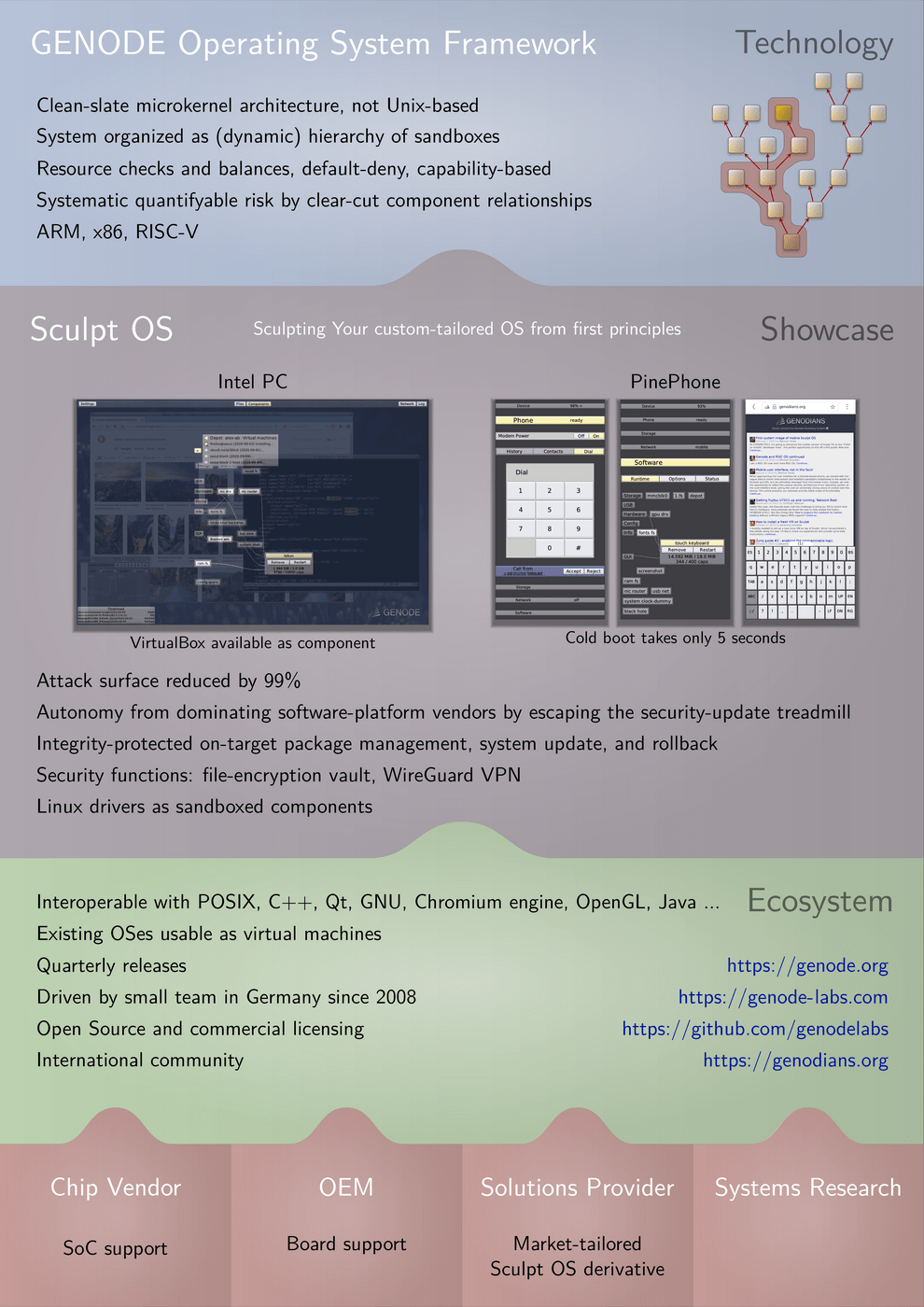
We understand the complexity of code and policy as the most fundamental security problem shared by modern general-purpose operating systems. Because of high functional demands and dynamic workloads, however, this complexity cannot be avoided. But it can be organized. Genode is a novel OS architecture that is able to master complexity by applying a strict organizational structure to all software components including device drivers, system services, and applications. The Genode OS framework is an open-source tool kit for building highly secure component-based operating systems. It scales from embedded devices to dynamic general-purpose computing.
- keywords
-
capability-based security, microkernel, principle of least authority, sandboxing, virtualization
The Books

The book "Genode Foundations" describes the Genode OS framework in a holistic and comprehensive way. It equips the reader with a thorough understanding of the architecture, assists developers with the explanation of the development environment and system configuration, and provides a look under the hood of the framework. Furthermore, it contains the specification of the framework's programming interface. Download as PDF or Browse online...

The "Genode Platforms" document complements the Genode Foundations book with low-level hardware-related topics. It is primarily intended for integrators and developers of device drivers. Download as PDF
Genode News
 RSS feed
-
 Genode OS Framework release 24.02
Feb 29, 2024
Genode OS Framework release 24.02
Feb 29, 2024
- Version 24.02 revisits Genode's audio support for latency-sensitive scenarios, flexible sample rates, and pluggable drivers. It also introduces the new ability of the Goa SDK to use Sculpt OS as remote test target, comes with a new TCP/IP stack based on Linux 6.1.20, makes drivers aware of suspend/resume, and improves HID event handling.
-
Road Map for 2024
Jan 18, 2024
- After intensively concentrating on deeply technical topics below the surface in 2023, we are going to reap user-visible rewards in 2024 by focussing on Sculpt OS usability.
-
Genode OS Framework release 23.11
Nov 30, 2023
- Genode 23.11 moves the IOMMU driver from the kernel to the user land, introduces CPU power/temperature/frequency monitoring and steering, comes with a new API for low-complexity GUI applications, and streamlines the framework's virtualization interface. It also improves developer ergonomics and showcases the port of the Linphone VoIP stack.
-
Sculpt OS release 23.10
Oct 26, 2023
- Modern PCs provide plenty of metering and power-management options. Version 23.10 of the Genode-based Sculpt operating system makes these features available via an interactive user interface. One can watch the temperature of each CPU core, monitor the individual CPU frequencies, switch between power profiles, and reveal details about power draw.
-
Genode OS Framework release 23.08
Aug 24, 2023
- The main theme of the current release is tooling for developing, debugging, porting, and publishing Genode components. Beyond that, the release improves driver support and the internals of core and the base-framework.
-
Genode OS Framework release 23.05
May 31, 2023
- Besides the annual documentation update, the scheduled tool-chain update, and the switch to C++20, the release puts the spotlight on the Goa tool, which enables the use of existing SDKs like Lomiri or Rust's cargo for targeting Genode.